Showing posts with label reviews. Show all posts

Thursday, August 27, 2020

Review: The Lays of Marie de France

The Lays of Marie de France The Lays of Marie de France by Marie de France
My rating: 5 of 5 stars

The Lays of Marie de France are a series of twelve short lays (narrative poems) in Old French. I read this translation as a library ebook, but it turns out that it is also available under a Creative Commons license:
https://www.aupress.ca/app/uploads/12...

The translator, David R Slavitt, writes:
Marie who? A number of suggestions have been proposed for the identity of this wonderful twelfth-century poet. Marie, Abbess of Shaftesbury, the illegitimate daughter of Geoffrey Plantagenet and half-sister to Henry II, King of England, is a plausible
candidate, but Marie, Abbess of Reading, Marie I of Boulogne, Marie, Abbess of Barking, and Marie de Meulan, wife of Hugh Talbot, are all possibilities. There were a lot of Maries, after all, but only a few who could read and write in English, Latin, and Anglo-Norman French. It is not inappropriate, however, for her to be a bit mysterious and even emblematic as the author of these strange, suggestive, and intriguing poems. One important thing we do know about her is that she also translated the Ysopet, a collection of 103 Aesopic fables, which could have influenced the
Lais but at least suggest something about her taste in literature. There is a fabulous quality to these poems, which are at one and the same time childish and very knowing, innocent and sophisticated.


From the first tale:
A good story deserves to be
well told. My gracious lords, Marie
understands her obligation
on such a fortunate occasion
when an interesting story
presents itself. And yet I worry
that any show of excellence
invites envy of women’s or men’s
achievements. Slanders, insults, and lies
attend me. Everybody tries
to sneer at whatever one composes —
they joke and even thumb their noses.
They are cowardly dogs that bite,
mean, malicious, and full of spite.
But I refuse to be deterred
as, line by line and word by word,
I do my best to compose my lay,
whatever the jealous critics say.
I shall relate some tales to you
from Brittany that I know are true
and worthy of your attention. In
a friendly spirit, let us begin.


The highlights for me were Bisclavret (one of the earliest werewolf stories!) and Lanval. Lanval is (I think) the only one set in king Arthur's court and I think I will want to come back to it after I have read Malory. Arthur holds a feast for the knights where he gives them all rewards for their great deeds but he forgets about Lanval who later sets out on a journey. He is wooed by a fairy lady who makes him rich, and must promise not to reveal her existence. I'm sure you can guess that a promise like that is going to cause problems for him down the road, but that would be telling! Ultimately it's a fun reversal of the traditional damsel in distress tale where a knight rescues a lady, but I'm not saying any more than that. Just read it.

There's also a very short lai concerning the romance of Tristan and Iseult. This one is so short that it was a little unsatisfying, but it made me want to read the longer version/s. I'm not sure when I will get around to it.


View all my reviews

Wednesday, August 26, 2020

Minireviews: The Drawing of the Dark/Haroun & the Sea of Stories/Hyperion/The Einstein Intersection

       
The Drawing of the Dark by Tim Powers *** 3 stars

This is one of Tim Powers's early novels and the first of his secret histories: several books with the shared premise that something supernatural is going on behind the scenes of history as we know it. It is set before and during the 1529 Siege of Vienna. Irishman Brian Duffy is working as a "bouncer" at an inn there when the siege begins. The first few chapters really drew me in, but the middle drags a bit (it is much shorter than Declare but doesn't feel like it) and the book as a whole didn't really come together for me. I might give The Anubis Gates another try (I didn't finish that one) and I want to try The Stress of Her Regard at some point. I was much more impressed with Declare (my review).

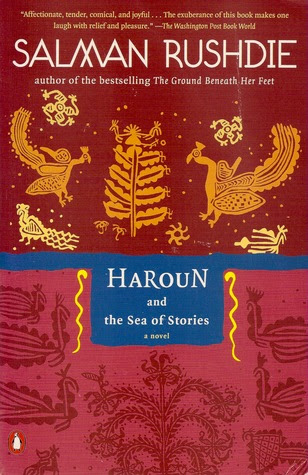
 Haroun and the Sea of Stories by Salman Rushdie *** 3 stars

A reread of a book I first read in 2012. I probably won't read it a third time but it was fun to revisit this. Haroun & the sea of stories begins in the country of Alifbay in a city ”so ruinously sad that it has forgotten its name.” Haroun is the only child of the storyteller Rashid Khalifa, and one day his father gets up in front of a huge audience, opens his mouth, and finds that he has run out of stories to tell. Harun sets out to fix that and discovers that the source of all stories is endangered by the villain Khattam-Shud, the Arch-Enemy of All Stories. 


Hyperion by Dan Simmons *** 3 stars

A Hugo Award Winner (1990) about six people on a journey to the planet Hyperion. In the style of the Canterbury Tales, each character tells a story explaining why they are going to Hyperion. I liked the scholar and the poet best I think. And maybe the detective. The soldier's tale is the only one that didn't really do much for me. The book has frequent allusions to John Keats, including the poem Hyperion, which is based on the lost epic poem the Titanomachy, which is about the struggle of the Olympian gods to overthrow their predecessors the Titans. That gave me a hint about some of the things that happen in the book. I don't like it enough to read the sequel right away but I will probably try it at some point.

People disagree about whether to stick with the first book, stop after the second book or read the whole series


I think I liked the other Delany books I have read better (Babel-17 and The Ballad of Beta-2 / Empire Star).

Here is what Neil Gaiman said about it in The Sandman Companion:
"My original plan [for The Song of Orpheus] was to do the equivalent of a series of jazz riffs, all on Orphic themes, spinning off of stories precisely like The Einstein Intersection. It would have been much weirder and more interesting than what I ended up writing." He says he kept hearing that people weren't familiar with the original story, so the story he wrote for Sandman was a more literal retelling.

Huh. Now that I've read The Einstein Intersection I can say that knowing the Orpheus story ahead of time (I finally read Metamorphoses in its entirety last year) didn't help. I will probably read something else by Delany someday (maybe Tales of Nevèrÿon but I am not a huge fan of his so far.

I listened to the audiobook read by Stefan Rudnicki from the library service hoopla digital. This book won the 1967 Nebula Award for Best Novel.


Review: Julian Comstock: A Story of 22nd-Century America (repost from GoodReads 2017)

Julian Comstock: A Story of 22nd-Century America Julian Comstock: A Story of 22nd-Century America by Robert Charles Wilson
My rating: 5 of 5 stars

This is a great adventure story - funny, dramatic, and bittersweet - and my favorite SF novel that I've read this year. The old-fashioned tone is completely convincing and switches easily between humorous moments and serious ones. The exposition is really well done, in such a way that it's probably quite accessible to people who don't read much SF (although it doesn't seem to be well known enough to get much of that readership).

Set a century and a half after a combination of peak oil + disease + economic collapse reduces modern civilization to Civil-War-level tech, this book takes place in a future North America where Canada is part of the United States, the presidency has become dynastic and is ruled by the Comstock family, and true political power is in the hands of the religious authority known as the Dominion. The post-apocalyptic society in the book emulates the 19th century, but it has all the American 19th century's flaws, without some of its key virtues; the actual 19th century was a time of overall progress, while the society in the book is clearly in decline. Oh, and the United States is at war with the Dutch over control of the Northwest Passage.

The narrator, Adam Hazzard, is a young writer. Adam makes friends with the president's nephew, Julian Comstock, whose life is loosely inspired by the life of Julian the Apostate. They get conscripted into the army while Julian is hiding his identity. Eventually Julian becomes a war hero and at the celebrations that follow, his actual identity is disclosed.

This review says that "Wilson himself described it by saying he was reading a US Civil War memoir called “Frank on a gunboat” and thought that was good as far as it went, but it would be better if it was Julian the Apostate on a gunboat and that's what this book is." Like the historical Julian, his goal is to reintroduce earlier traditions, but in this case, that means reimposing separation of church and state as public policy. Also, he wants to make a film about Darwin.

Along with Eifelheim Michael Flynn and Doomsday Book by Connie Willis this is one of the better science fiction books I've read that deals with religion although this one is coming at it from the other (irreligious) side. I loved everything about it and I will definitely read it again someday. 

“You must not make the mistake of thinking that because nothing lasts, nothing matters.”

There's an interesting interview with the author here
.


View all my reviews

Monday, August 24, 2020

Review: The Obelisk Gate

The Obelisk Gate The Obelisk Gate by N.K. Jemisin
My rating: 4 of 5 stars 
Synopsis from GoodReads: This is the way the world ends... for the last time.

The season of endings grows darker as civilization fades into the long cold night. Alabaster Tenring – madman, world-crusher, savior – has returned with a mission: to train his successor, Essun, and thus seal the fate of the Stillness forever.

It continues with a lost daughter, found by the enemy.

It continues with the obelisks, and an ancient mystery converging on answers at last.

The Stillness is the wall which stands against the flow of tradition, the spark of hope long buried under the thickening ashfall. And it will not be broken.  

I'm afraid this book suffers a little from being the second book in a trilogy. There is a great deal of exposition here and for some reason, I didn't find those sections as engaging to read as in the first book. I will reread The Stone Sky soon (probably some time in the next few weeks) but I hope I don't forget anything important, because some of the details of the setting just didn't stick in my head the way they have with other books. (I am one of those people who loved all the footnotes in Jonathan Strange & Mr. Norrell, so I can really get into this sort of thing with the right book.)

This book is told from three perspectives: Essun, Nassun, and Schaffa. Most of that slightly frustrating exposition is in Essun's chapters. Essun spent most of the first book searching for her daughter, and in this book we find out where she is: her father Jija took her to a community called Found Moon hoping to cure her orogeny. Nassun's chapters have a lot more dramatic tension than Essun's, and we learn a lot about her difficult relationship with her both her parents. I liked having Schaffa's point of view; in the first book he's almost a villain but I had some sympathy for him here. 

This is a tricky book to review because there are some things I'd like to discuss (mostly related to the ruthlessness of the characters) that would involve spoilers. I never discuss spoilers in reviews but for The Stone Sky I might have to. I'll figure out what to do about that when I read it, I guess. 

Some of my favorite quotes:
But if you stay, no part of this comm gets to decide that any part of this comm is expendable. No voting on who gets to be people.  

It's not hate that you're seeing. Hate requires emotion. What this woman has simply done is realize that you are a rogga, and decide that you aren't a person, just like that.


View all my reviews

Thursday, August 6, 2020

Review: The Hobbit, or There and Back Again

The Hobbit, or There and Back Again The Hobbit, or There and Back Again by J.R.R. Tolkien
My rating: 4 of 5 stars

I read The Hobbit, or There and Back Again years ago after I read The Lord of the Rings for the first time. I liked it, but I didn't feel compelled to read it again. I reread it in June. I still don't like it nearly as much as The Lord of the Rings, but it was worth the reread.

The Hobbit was first published in 1937. Tolkien didn't originally plan to write a sequel and wasn't sure whether it would fit into the stories of Middle-earth that he had been working on for decades (then the early versions that were later published as The Book of Lost Tales). I have the revised edition from 1966, in which chapter five, Riddles in the Dark, was changed to make it more consistent with The Lord of the Rings

The wizard Gandalf persuades Bilbo Baggins to join the dwarf Thorin Oakenshield and his companions, who are setting out to reclaim the Lonely Mountain and its treasure from the dragon Smaug.

Far over the misty mountains cold
To dungeons deep and caverns old
We must away ere break of day
To seek the pale enchanted gold.

The dwarves of yore made mighty spells,
While hammers fell like ringing bells
In places deep, where dark things sleep,
In hollow halls beneath the fells.


I like the dwarven songs, but the goblin songs (which come later) are kind of ridiculous; the larger problem, I guess, is that the goblins (and the trolls) are just a little too silly as antagonists. The songs of the elves are far more frivolous than either the elven songs in LotR or the dwarven songs here. It seemed weird at first, but I suppose elves can't be serious all the time. The riddle game in chapter five is great, but apart from that, things get much more interesting in the second half (or so) the part where Bilbo and the dwarves stay with Beorn, a skin-changer who changes into a bear. From there it gets more intense as it goes on. It is not as descriptive as LotR, and the descriptions in LotR are one of my favorite things so it's not surprising that I don't like The Hobbit quite as much.  

After reading this I listened to the 1979 radio adaptation by The Mind's Eye. I definitely recommend it! I thought the voice acting & songs were great.

There's a bit of weirdness where the Elvenking of Mirkwood is implied to be the same person who was involved in the original ancient quarrel between the Elves and Dwarves:  
In ancient days they had had wars with some of the dwarves, whom they accused of stealing their treasure. It is only fair to say that the dwarves gave a different account, and said that they only took what was their due, for the elf-king had bargained with them to shape his raw gold and silver, and had afterwards refused to give them their pay.

In The Silmarillion as it was eventually published this is definitely before the Elvenking's time, and a different character.
  
There is a quote from Tolkien's letters (which I haven't read; I am taking this from The History of Middle-earth vol 3) that says this about his discussions with his publisher after The Hobbit was published:
I then (after the publication of The Hobbit) offered them the legends of the Elder Days, but their readers turned that down. They wanted a sequel -- but I wanted heroic legends and high romance. The result was The Lord of the Rings.  


Favorite quotes:

“Do you wish me a good morning, or mean that it is a good morning whether I want it or not; or that you feel good this morning; or that it is a morning to be good on?”

“As they sang the hobbit felt the love of beautiful things made by hands and by cunning and by magic moving through him, a fierce and jealous love, the desire of the hearts of dwarves. Then something Tookish woke up inside him, and he wished to go and see the great mountains, and hear the pine-trees and the waterfalls, and explore the caves, and wear a sword instead of a walking-stick.”

“Roads go ever ever on,
Over rock and under tree,
By caves where never sun has shone,
By streams that never find the sea;
Over snow by winter sown,
And through the merry flowers of June,
Over grass and over stone,
And under mountains of the moon.

Roads go ever ever on
Under cloud and under star,
Yet feet that wandering have gone
Turn at last to home afar.
Eyes that fire and sword have seen
And horror in the halls of stone
Look at last on meadows green
And trees and hills they long have known”


Saturday, June 13, 2020

Review: The Fifth Season

The Fifth Season The Fifth Season by N.K. Jemisin
My rating: 5 of 5 stars

“Winter, Spring, Summer, Fall; Death is the fifth, and master of all”

Synopsis from GoodReads: Three terrible things happen in a single day. Essun, a woman living an ordinary life in a small town, comes home to find that her husband has brutally murdered their son and kidnapped their daughter. Meanwhile, mighty Sanze -- the world-spanning empire whose innovations have been civilization's bedrock for a thousand years -- collapses as most of its citizens are murdered to serve a madman's vengeance. And worst of all, across the heart of the vast continent known as the Stillness, a great red rift has been torn into the heart of the earth, spewing ash enough to darken the sky for years. Or centuries.

The book opens with the beginning of the worst Fifth Season in recorded history. The government maintains the Fulcrum, an army of enslaved orogenes with the ability to control energy, particularly that of the ground and temperature. Their abilities give them power geological activity and temperature so that they can both cause and prevent earthquakes.

The Fifth Season is the first book in the Broken Earth Trilogy. I think it could fit into either science fiction or fantasy; it is hard to tell because it leans so heavily on Clarke's Third Law

The Fifth Season is darker than most books I read. I suspect the question of whether it has a pessimistic worldview doesn't make much sense outside the context of the trilogy as a whole, so I will come back to that when I finish rereading The Obelisk Gate and The Stone Sky.

The first book is technically mostly setup when you look at it in relation to the other books, but
it doesn't feel that way! I think this is something to do with how the book does so much of its worldbuilding through characterization & plot. In this book, all those things go together perfectly, while the other books rely more on exposition.

There are three points of view: the young girl Damaya, in training as an orogene; the young woman Syenite; and the grieving mother Essun. Essun's perspective is given in second person and present tense; there is a plot-related reason for that, but Jemisin doesn't reveal it in the first book. I loved the writing! Essun's perspective felt odd at first but I got used to it. Here are some of my favorite quotes:

- “Yumenes is not unique because of its size. There are many large cities in this part of the world, chain-linked along the equator like a continental girdle. Elsewhere in the world villages rarely grow into towns, and towns rarely become cities, because all such polities are hard to keep alive when the earth keeps trying to eat them… but Yumenes has been stable for most of its twenty-seven centuries.
Yumenes is unique because here alone have human beings dared to build not for safety, not for comfort, not even for beauty, but for bravery. The city’s walls are a masterwork of delicate mosaics and embossing detailing its people’s long and brutal history. The clumping masses of its buildings are punctuated by great high towers like fingers of stone, hand-wrought lanterns powered by the modern marvel of hydroelectricity, delicately arching bridges woven of glass and audacity, and architectural structures called balconies that are so simple, yet so breathtakingly foolish, that no one has ever built them before in written history. (But much of history is unwritten. Remember this.)”

- “This is what you must remember: the ending of one story is just the beginning of another. This has happened before, after all. People die. old orders pass. New societies are born. When we say the world has ended, it's usually a lie, because the planet is just fine. But this is the way the world ends. This is the way the world ends. This is the way the world ends. For the last time.”

- “Friends do not exist. The Fulcrum is not a school. Grits are not children. Orogenes are not people. Weapons have no need of friends.”

Tuesday, May 19, 2020

Review: Chocolat

Chocolat Chocolat by Joanne Harris
My rating: 5 of 5 stars

Chocolat is a contemporary novel with a few fantasy elements. I really liked the setting, which is one of most beautiful and immersive settings I've read about lately. This is the second time I have read the book. It was worth rereading, but not amazing enough for me to read it a third time, most likely.

The beginning:
We came on the wind of the carnival. A warm wind for February, laden with the hot greasy scents of frying pancakes and sausages and powdery-sweet waffles cooked on the hot plate right there by the roadside, with the confetti sleeting down collars and cuffs and rolling in the gutters like an idiot antidote to winter. There is a febrile excitement in the crowds that line the narrow main street, necks craning to catch sight of the crêpe-covered char with its trailing ribbons and paper rosettes. Anouk watches, eyes wide, a yellow ribbon in one hand and a toy trumpet in the other, from between a shopping basket and a sad brown dog. We have seen carnivals before, she and I; a procession of two hundred and fifty of the decorated chars in Paris last Mardi Gras, a hundred and eighty in New York, two dozen marching bands in Vienna, clowns on stilts, the Grosses Tetes with their lolling papier-mâché heads, drum majorettes with batons spinning and sparkling. But at six the world retains a special luster. A wooden cart, hastily decorated with gilt and crêpe and scenes from fairy tales. A dragon's head on a shield, Rapunzel in a woolen wig, a mermaid with a cellophane tail, a gingerbread house all icing and gilded cardboard, a witch in the doorway, waggling extravagant green fingernails at a group of silent children... At six it is possible to perceive subtleties that a year later are already out of reach.

The plot:
Vianne Rocher and her daughter Anouk move to the French village of Lansquenet, where Vianne sets up a chocolaterie called La Céleste Praline. When the book opens, it is Mardi Gras. They arrive in town during the carnival. The shop is on the square opposite the church and clashes with the old-fashioned town's strict observation of Lent.

Vianne is the main point-of-view character, but Pere Reynaud, the local priest, who has a vendetta against Vianne, gets some chapters from his point of view. I also enjoyed the secondary characters.

The magic:
The magic is understated, but it is a bigger deal in the book than the film. The main character knows what each character's favorite chocolates or sweets are as soon as she meets them, because she can read their thoughts. Tarot cards play a role, although they may or may not actually reveal the future.

The antagonist:
Reynaud is great, and I don't think he's a cartoon villain. This is a gray hats vs white hats type of conflict. The film made the mayor the antagonist instead, so if you have only seen the movie you might want to check out the book version.

The ending:
The ending is bittersweet, but not too sad, and it leaves a few loose ends. In contrast, the film comes closer to tying things up in a neat little bow. (Softening the impact of a bittersweet ending is not exactly new in film adaptations, so I really should have expected it. Stardust by Neil Gaiman comes to mind.)

View all my reviews

Thursday, May 14, 2020

Review: Midnight's Children

Midnight's Children Midnight's Children by Salman Rushdie
My rating: 5 of 5 stars

I first read Midnight's Children in 2012, but that was my second attempt to read the book. The first time was the previous year, I think. I couldn't get through it the first time, even though I really liked the beginning. But once I got the hang of it, I loved it! 

I knew a little bit about Indian history before reading it. I had at least heard of some of the famous people mentioned, but I'm not sure how necessary that is. Jo Walton talks about that issue in her review of the book at Tor.com:

Midnight’s Children invites you to immerse yourself in India the way you would with a fantasy world—and I think that was partly Rushdie’s intention. He was living in England when he wrote it. He’s talked about how writers like Paul Scott and E.M. Forster were untrue to the real India, and with this book I think he wanted to make his vision of India something all readers, whether they start from inside or outside that culture, could throw themselves into. I don’t think his intention was to teach Indian history, though you’ll certainly pick some up from reading it, so much as to demonstrate the experience of being plunged into Indian history, as Saleem is plunged into it at birth.

The novel starts with the main character, Saleem Sinai, describing his birth. He is telling his life story to his fiancee, Padma. And he is dying, so he doesn't have much time. Saleem starts by telling of his birth in the exact moment that India became an independent country. He then backs up to recount the story of how his grandparents met, and then the story of how his parents met. Most of Book One takes place before Saleem's birth. His family is Muslim, but since he grows up in Bombay, Hinduism figures prominently in the book as well. I had to look up a few things, but I found it pretty accessible without a vast knowledge of Indian mythology.

"Family history, of course, has its proper dietary laws. One is supposed to swallow and digest only the permitted parts of it, the halal portions of the past, drained of their redness, their blood. Unfortunately, this makes the story less juicy; so I am about to become the first and only member of my family to flout the laws of halal."

And eventually he comes back to the moment of India's independence:

" ... this year-- fourteen hours to go, thirteen, twelve-- there was an extra festival on the calendar, a new myth to celebrate, because a nation which had never previously existed was about to celebrate its freedom, catapulting us into a world which, although it had five thousand years of history, although it had invented the game of chess and traded with Middle Kingdom Egypt was nevertheless quite imaginary; into a mythical land, a country which would never exist except by the efforts of a phenomenal collective will -- except in a dream we all agreed to dream; it was a mass fantasy shared in varying degrees by Bengali and Punjabi, Madrasi and Jat, and would periodically need the sanctification and renewal which can only be provided by rituals of blood. India, the new myth, rivalled only by the two other mighty fantasies: money and God."

Book Two begins when Saleem is born. The premise of the book is that Saleem and other children born in the hour from midnight to 1 pm have magical powers. Saleem and Shiva, both born exactly at midnight, are the two most powerful. Saleem is telepathic, and later, he gains an extraordinary sense of smell. Shiva's powers aren't described in detail but he lives up to his name: Shiva the destroyer. Book Two covers Saleem's life until the end of the 1965 war between India and Pakistan (April to September). And then, "six years later... there was another war."

"Reality can have metaphorical content; that does not make it less real. A thousand and one children were born; there were a thousand and one possibilities which had never been present in one place at one time before; there were a thousand and one dead ends. Midnight's children can be made to represent many things, according to your point of view: they can be seen as the last throw of everything antiquated and regressive in our myth-ridden nation, whose defeat was entirely desirable in the context of a modernizing, 20th-century economy; or as the true hope of freedom, which is now forever extinguished; but what they must not become is the bizarre creation of a rambling, diseased mind."

The children, or at least 581 of them, find each other with the help of Saleem's telepathy. Their unity is as tenuous as India's national unity, as it turns out.

I can't really classify this novel as either comic or tragic. It is a book of contrasts. It is pretty disturbing at times, though. Let's see, there's torture, alcoholism, domestic violence, and misogyny, so if all that is too much for you, this may not be your kind of book. This is one of my favorite novels, in case you can't tell from how much I'm quoting it! The events of Book Three lead up to one of my favorite endings; it's fantastic, but I'm not sure I can even discuss it without giving too much away. 

"All games have morals, and the game of snakes and ladders captures, as no other activity can hope to do, the eternal truth that for every ladder you climb, a snake is waiting just around the corner; and for every snake, a ladder will compensate."

I'd like to say something about the portrayal of women, but I'm not sure how to address that without going into great detail about exactly what happens in the book. There are several important female characters: Saleem's maternal grandmother, Naseem Aziz; his mother, Mumtaz, who takes a second name, Amina, after her second marriage; his aunt Alia; his sister, the Brass Monkey (the name comes from an English expression); his crush at school, Evie Burns; Parvati, one of the Midnight's Children; and Padma, Saleem's lover and, eventually, his fiancée. They are all very vivid characters.  

"How are we to understand my too many women? As the multiple faces of Bharat-Mata? or as even more... as the dynamic aspect of Maya, as cosmic energy, which is represented by the female organ?
Maya, in its dynamic aspect, is called Shakti; perhaps it is no accident that, in the Hindu pantheon, the active power of the deity is contained within his queen! Maya-Shakti mothers, but also muffles consciousness in its dream-web. Too many women; are they all aspects of Devi, the goddess, who slew the buffalo-demon, who defeated the ogre Mahisha, who is Kali Durga Chandi Chumunda Uma Sati and Parvati... and who, when active, is colored red?

'I don't know about that,' Padma brings me down to earth, 'They are just women, that's all.'"


The Encyclopedia of Fantasy (1997) entry for Rushdie mentions Gunter Grass's The Tin Drum as a possible influence. I don't think I have heard of that book, so I will have to look it up. And in the comments at the Tor review I linked, someone mentions The Life and Opinions of Tristram Shandy, Gentleman as a possible influence, or at least a book with some interesting parallels. I haven't read that either! Maybe I'll get to it after I read a few of the other very long books I am already planning to read. I don't consider this book all that long, really; considering all the things that happen in it, it is actually pretty short, but dense!

Rushdie has an interesting essay on unreliable narration in the book, which you can read here.

View all my reviews

Tuesday, May 5, 2020

Review: Njal's Saga (repost from GoodReads, 2018)

Njal's Saga Njal's Saga by Anonymous
My rating: 5 of 5 stars

Blood rains
From the cloudy web
On the broad loom
Of slaughter.
The web of man,
Grey as armor,
Is now being woven;
The Valkyries
Will cross it
With a crimson welt.


Njal’s Saga, written by an unknown author in the 13th century (around the year 1280), is often regarded as the greatest of the Icelandic sagas. It is primarily a prose narrative, but there are some passages of verse. 24 manuscripts, more copies than of any other saga, have survived, sometimes in fragments. The saga is based on historical events that took place roughly 300 years earlier. This is the Penguin classics edition translated by Magnus Magnusson and Herman Palsson, with maps and family trees, as well as an index of characters that lists the events each character took part in corresponding to the chapters that cover those events.

The lack of internal analysis in a narrative like this means that, apart from some brief character sketches, the reader has to rely on action and dialogue to get a sense of the characters’ motives. The saga is a very bleak tale of cascading family feuds which the warring parties attempt, unsuccessfully, to resolve through Iceland’s medieval legal system. (A good chunk of the second half of the saga is basically a legal drama, possibly the earliest in European literature.) When they fail to reach a settlement, the story culminates in the death of Njal, one of the most respected Icelanders. He and his sons are burned to death in their house.

There are some magical elements (especially in the form of visions) but the focus is on other things, and it isn't as fantastical as The Saga of the Volsungs or The Prose Edda. On the other hand this saga reflects a self-critical side of the saga literature, because it definitely shows an awareness that the Norse heroic ethic can kinda suck.

He was a gentle man of great integrity; he remembered the past and discerned the future, and solved the problems of any man who came to him for help.

View all my reviews

Review: Fire Watch (repost from GoodReads, 2016)

Fire Watch Fire Watch by Connie Willis
My rating: 3 of 5 stars

This collection contains 12 stories.

The title story, "Fire Watch" is a bittersweet tale set in the same universe as Doomsday Book and To Say Nothing of the Dog, but written earlier. It was published in 1982, and won the 1983 Hugo & Nebula Awards for Best Short Story. The narrator is a time-traveling grad student from a future Oxford University, who is sent to the London Blitz due to a clerical error. (He was supposed to travel with St Paul for his practical exam, but instead ends up assigned to the Fire Watch for St Paul’s Cathedral.) Of course, he is completely unprepared and has no idea what’s going on. The epigraph for this story comes from Sir Walter Raleigh: "History hath triumphed over time, which besides it nothing but eternity hath triumphed over." 5 stars *****
This story is available online here: http://www.infinityplus.co.uk/stories...

"Service for the Burial of the Dead" is a ghost story from the perspective of the former girlfriend of a dead man who attends his funeral. She meets him there, apparently still alive.***

"Lost and Found" - The end of the world, and the search for the Holy Grail. Like "Samaritan" below, this is a religious story. I don’t have much to say about this one. **

"All My Darling Daughters" is the most disturbing story in the collection. Set on a boarding school in L5 orbit, it is told by a female narrator who has just been assigned a new roommate. The story revolves around the mystery of her roommate and the strange animals (“tessels”) that the boys are carrying around… this is much nastier than the other stories, but I thought it was powerful. ****

"The Father of the Bride"- Sleeping Beauty’s father reacts to being awoken in the Middle Ages. Short and clever. ***

"A Letter from the Clearys" - This tale of a family in a post-apocalyptic world won the Nebula Award for Best Short Story in 1982. It’s hard to describe this one to someone who hasn’t read it, so I’ll just say that the 14-year old girl is an excellent unreliable narrator. Like "All My Darling Daughters" this is a slowly unfolding horror story, although it’s not quite as dark as that one.***

"And Come from Miles Around" - A family watches a solar eclipse.**

"The Sidon in the Mirror" - A 'Mirror' - a mutant with the uncontrolled ability to become other people - tries to discover who he’s copying, as he can’t tell while he’s doing it. ***

"Daisy, in the Sun" is another apocalyptic story, told in a series of flashbacks. In the introduction to this story, Willis writes, "During the London Blitz, Edward R. Murrow was startled to see a fire engine racing past. It was the middle of the day, the sirens had not gone, and he hadn’t heard any bombers. He could not imagine where a fire engine could be going. It came to him, after much thought, that it was going to an ordinary house fire, and that that seemed somehow impossible, as if all ordinary disasters should be suspended for the duration of this great Disaster that was facing London and commanding everybody’s attention. But of course houses caught fire and burned for reasons that had nothing to do with the Blitz, and even in the face of Armageddon, there are still private Armageddons to be faced." ***

"Mail Order Clone" is about, well, a mail order clone, and the problems it causes for the man who orders it.**

"Samaritan" - A young assistant pastor plunges the church hierarchy into a storm of controversy when she brings forward an orangutan who can use sign language to be baptized.**

"Blued Moon" - A romantic comedy interwoven with an sf plot which involves a controversy over a project at chemical plant to restore the ozone layer and a series of coincidences with a scientific cause.***


View all my reviews

Sunday, May 3, 2020

Review: The Sandman, Vol. 3: Dream Country (repost from 2016)

The Sandman, Vol. 3: Dream Country


The Sandman, Vol. 3: Dream Country by Neil Gaiman
My rating: 4 of 5 stars


This volume is a collection of four short stories, one of which, "A Midsummer Night's Dream," won the World Fantasy Award for Best Short Story. This is where I started reading the series, and it stands alone pretty well. I think either this, or The Sandman, Vol. 2: The Doll's House are the best places to start - but everything ties together eventually, so once you have a good idea of what the series is capable of, it’s worth going back to the first one.

In "Calliope" a frustrated writer keeps the Greek muse Calliope captive as a source of inspiration. This story is the most violent in the collection, and the art is just a bit too graphic for my taste this time. "24 Hours" in The Sandman, Vol. 1: Preludes and Nocturnes, was even more violent, but somehow, it seemed more like a necessary part of the psychological horror. Still, this story is an important part of the overall arc of Sandman, as it begins to examine how Dream has been changed by his captivity. **

"A Dream of a Thousand Cats" is about a cat’s quest to find Cat of Dreams, who tells her why cats live under human rule, and how they can restore their rightful place in the world. It’s a lighthearted story with a bit of a dark edge to it, as the cat speaks longingly of a world in which large cats could hunt tiny humans - not primarily for food or even revenge, but just as part of "the game of cat and man." ***

"A Midsummer Night’s Dream" is, along with "Men of Good Fortune," one of my favorite stories at this point in the series. This is a tale of the very first performance of "A Midsummer Night’s Dream," and beautifully illustrated by Charles Vess. This story follows up on the deal that William Shakespeare made with Dream (to write two plays), when they met in the earlier story "Men of Good Fortune." Dream’s realm is associated with both dreams and stories, so in some sense he has an influence on all imaginative literature, but his influence is more direct here.

Gaiman switches between the performance of the play and the members of the audience, which includes the fairy court of Auberon and Titania, as well as Morpheus. One of my favorite things about this story is the way he shows the vast gulf between the mortal and immortal characters. Shakespeare’s reaction to the news of Christopher Marlowe’s death is a particularly striking example.

The most memorable part of the story, though, features Shakespeare’s son Hamnet, who was a real person. He died at the age of eleven, three years after this story takes place. Scholars have speculated about how Shakespeare’s relationship with his son might have influenced plays”>his work. In this interpretation, Hamnet has a strained relationship with his father, who is consumed by his responsibilities to his profession. His presence in the story keeps it a bit more down to earth than it would be otherwise. For anyone who's interested there’s an excellent analysis of this story on Stephen Frug's blog. *****

Facade - This is the first issue of Sandman that doesn’t feature The Sandman. It seems a bit out of place at first, but Dream’s comment in the previous issue that "the price of getting what you want, is getting what you once wanted" applies well to the protagonist of this story. Urania Blackwell, the Element Girl of DC Comics, no longer wants her undying, superhuman form, but can’t find a way to escape it. I don’t know anything about this character outside of her appearance here, but I think it’s an interesting parallel to “Calliope,” as a story about a character who has to let go of the past. (At the end of that story, Calliope said she would return to the minds of men - in other words, she’ll be in the "dream country" that’s referenced in this story.) ***

favorite quotes:

"A sestina about silence, using the words dark, ragged, never, screaming, fire, kiss."

"A man who inherits a library card to the library in Alexandria."

"Little one, I would like to see anyone - prophet, king, or god - persuade a thousand cats to do anything at the same time."

"I am that merry wanderer of the night? I am that giggling-dangerous-totally-bloody-psychotic menace to life and limb, more like it." - the fairy Peaseblossom (the real one) watching Puck (played by an actor)

"Things need not to have happened to be true. Tales and dreams are the shadow-truths that will endure when mere facts are dust and ashes, and forgot."

"The price of getting what you want, is getting what you once wanted."

"You people always hold on to old identities, old faces and masks, long after they’ve served their purpose. But you’ve got to learn to throw things away eventually."

View all my reviews

Review: Two Plays for Voices (repost from GoodReads, 2016)

Two Plays for Voices Two Plays for Voices by Neil Gaiman
My rating: 4 of 5 stars

This full cast audio CD includes 2 short stories previously published in Smoke and Mirrors: Short Fiction and Illusions. There are some gruesome bits in both stories, but I didn't find them gratuitous. The highlight is definitely "Murder Mysteries" which I think is the best of Gaiman’s short stories that he's written outside of comics.

"Snow, Glass, Apples" is a retelling of Snow White, from the stepmother’s point of view, in which (view spoiler) It’s elegant and creepy - this version really isn’t a children’s story, any more than the original was. The basic idea is one I’ve seen before, though. Tanith Lee did it first in "Red As Blood," Red as Blood, or Tales from the Sisters Grimmer although that one has a very different ending. I'd probably give this 3 stars if I were rating it separately.

"Murder Mysteries" is a story within a story. In the frame story, the narrator, a British man, remembers a time when he was stuck in Los Angeles while trying to get back home. He briefly hooks up with an old girlfriend, and after leaving her apartment he meets an old man who tells him a story in exchange for some cigarettes. The old man claims that he was once the angel Raguel, charged with carrying out the Lord’s vengeance. He explains how he investigated the first crime in the history of the universe, the murder of an angel in the Silver City, the precursor of Heaven. There was no obvious motive, so there was no obvious suspect -- but Raguel was willing to interview everyone in the City if he had to.

The full cast performance is absolutely captivating, and the eerie music is great.

"Perhaps it is true that all that happens is in accordance with Your Will, and thus it is good. But sometimes You leave blood on Your instruments."

View all my reviews

Review: Death: The Time of Your Life (repost from GoodReads, 2017)

Death: The Time of Your Life Death: The Time of Your Life by Neil Gaiman
My rating: 5 of 5 stars

"Can I ask a stupid question?"
"Sure. Ask away."
"It's sort of more than one question. But... Look, um... Why do we hurt? Why do we die? Why isn't life good all the time? Why isn't it fair?"
"Those aren't stupid questions, Hazel. For some people they're the only questions that matter."
"Does that mean you won't answer them?"
"Sure, I'll answer. But it's kind of a big subject, and it's got lots of answers, and the answers don't really mean anything-- They aren't stupid questions but they could just as well be 'When is purple?' or 'Why does Thursday?', if you see what I mean..."
"Not really."
"Well, I think some of it is probably contrasts. Light and Shadow. If you never had the bad times, how would you know you had the good times? But some of it is just: If you're going to be Human, then there are a whole load of things that come with it. Eyes, a Heart, Days and Life.
It's the moments that illuminate it, though. The times you don't see when you're having them... They make the rest of it matter."


Like Death: The High Cost of Living Collected, this volume mostly stands apart from the main Sandman series, so it can probably be read alone. But the main characters are from that series, so reading this separately would mean missing some of the context.

I love the art for this volume, which is pencilled by Chris Bachalo & Mark Buckingham, and inked by Mark Buckingham & Mark Pennington. The way Death is drawn here is one of my favorite renditions of her, along with Mike Dringenberg (The Sandman, Vol. 4: Season of Mists), and Marc Hempel (The Kindly Ones) in the main series.

This volume brings Hazel & Foxglove, the lesbian couple that first appeared in The Sandman, Vol. 5: A Game of You back for a story focused on their relationship. I think this is the stronger of the two Death volumes, but this is one of those times when I’ve already read a great review and would rather link to it than write one myself. I loved Tim Callahan’s take from Tor.com’s 2013 Sandman reread:
http://www.tor.com/2013/04/03/the-san...

View all my reviews

Review: Trigger Warning: Short Fictions and Disturbances (repost from GoodReads, 2017)

Trigger Warning: Short Fictions and Disturbances Trigger Warning: Short Fictions and Disturbances by Neil Gaiman
My rating: 3 of 5 stars

The highlights of this collection, for me, were "The Truth is a Cave in the Black Mountains," "A Calendar of Tales" and "The Sleeper and the Spindle" (the last of which I'd listened to before, as a separate audio CD).

"A Lunar Labyrinth" - An atmospheric, slightly creepy story. Gaiman mentions in the introduction that it's an homage to Gene Wolfe’s “A Solar Labyrinth” which I have now had a chance to read. The Wolfe story is available online with the permission of the author:
http://ultan.org.uk/a-solar-labyrinth/

(The Wolfe story is excellent - one of those stories that is more unsettling for the things it never quite spells out.)

"The Thing About Cassandra" - This was clever. A man meets a woman from out of his high school fantasies. There’s an additional twist, but I won’t give it away…

"Down to a Sunless Sea" - A creepy story about a sea voyage. This one is available online, and I had read it before.
https://www.theguardian.com/books/201...

"The Truth is a Cave in the Black Mountains" - This might be the best story in the collection, and probably has my favorite opening of all of them. It’s a dark story of revenge, love, and loss.

You ask me if I can forgive myself? I can forgive myself for many things. For where I left him. For what I did. But I will not forgive myself for the year that I hated my daughter, when I believed her to have run away, perhaps to the city. During that year I forbade her name to be mentioned, and if her name entered my prayers when I prayed, it was to ask that she would one day learn the meaning of what she had done, of the dishonour that she had brought to my family, of the red that ringed her mother’s eyes.

I hate myself for that, and nothing will ease that, not even what happened that night, on the side of the mountain.


"Orange" - A whimsical story in which a girl explains her sister’s encounter with aliens in her answers to a police interview. I thought bits of this were pretty funny.

"A Calendar of Tales" - I really enjoyed this. It’s a series of very short stories, one for each month of the year. "April" was funny; "August" is a pretty good disaster story; "September" is eerie.
This one is online, with audio and text, at:
http://www.acalendaroftales.com/

"The Case of Death and Honey" - A Sherlock Holmes story, featuring Old Gao, a Chinese beekeeper, who tolerates the extended visit of an elderly white man who comes to study his bees. The man is Sherlock Holmes…

"The Man Who Forgot Ray Bradbury" - This was written in honor of Ray Bradbury, and it works in a bunch of references to Bradbury’s work. It’s a strange story about a man who is losing his memory.

"An Invocation of Incuriosity" - Gaiman says in his introduction that this one was written for a collection of stories inspired by Jack Vance's The Dying Earth, and it does have that feel to it. (I've read some of those stories, but only the first volume.) The narrator meets a mysterious ancient being at a flea market.

"The Sleeper and the Spindle" - I like this one a lot. I listened to it last year as a separate audio CD. This is a fairytale retelling, combining elements from Sleeping Beauty and Snow White. The story starts with a recovered Snow White as queen of her own kingdom, and with three nameless dwarves, all that remain of the original seven dwarves. The dwarves discover that a neighboring kingdom is falling under some sort of sleeping spell; the princess there has been cursed many years before, and the curse, which was at first confined to the princess’s castle, is slowly spreading to cover the whole land. Snow White, having previously broken the sleeping spell that was placed on her (this is backstory, and there isn’t much said about it - I would have liked a bit more detail) travels to the neighboring kingdom to rescue the princess.

Black Dog - A longer story set in the universe of American Gods. It was pretty good, but my attention wandered a bit during this one, maybe because of length or maybe because I'm not a fan of that book - I didn’t finish it - and so I wasn't as engaged by this one as a lot of Gaiman’s other readers probably would be.

View all my reviews

Thursday, April 30, 2020

Review: Space Opera

Space Opera Space Opera by Catherynne M. Valente
My rating: 4 of 5 stars

I have read one other book by the author, Deathless ,a fantasy set during the Russian Revolution. It is much darker than this one, which is a comedy. The premise is basically a galactic version of the Eurovision Song Contest: the Megagalatic Grand Prix, invented in the wake of interstellar wars.

When it was all done and said and shot and ignited and vaporized and swept up and put away and both sincerely and insincerely apologized for, everyone left standing knew that the galaxy could not bear a second go at this sort of thing. Something had to be done. Something mad and real and bright. Something that would bring all the shattered worlds together as one civilization.

You don't have to win to survive, just don't be dead last!

It's pretty obvious that this book is influenced by the Hitchhikers Guide to the Galaxy. I caught a few brief references, but the main thing this book takes from Adams is the concept behind the nonfiction-style entries for laws of the universe that are known as Goguenar Gorecannon's Unkillable Facts. For example:

Seventh Unkillable Fact: Dying happens to everyone, even stars. Even the stuff between the stars. But if you believe in yourself and achieve your goals, you can die so hard that no one will ever forget you, and that’s almost as good as not dying at all. Well, it isn’t, really, it isn’t at all, and believing and achieving is just something sportscasters say, but what are you gonna do, not die? Try it. I’ll wait.

But it didn't feel overly derivative to me. This was a lot of fun, and the silliest book I have read in a long time. There is a plot, sort of, or at least a bunch of things happen, and there are main characters, namely the members of a defunct glam rock band called Decibel Jones and the Absolute Zeroes. But mostly I liked this book for the narrator, who is highly quotable.

But in the end, all wars are more or less the same. If you dig down through the layers of caramel corn and peanuts and choking, burning death, you’ll find the prize at the bottom and the prize is a question and the question is this: Which of us are people and which of us are meat?

View all my reviews

Monday, April 27, 2020

Review: Splintered Light: Logos and Language in Tolkien's World (repost from GoodReads, 2018)

Splintered Light: Logos and Language in Tolkien's World Splintered Light: Logos and Language in Tolkien's World by Verlyn Flieger
My rating: 5 of 5 stars

It would probably be ideal to read this right after reading The Silmarillion. I would have, if I had known about it at the time. I decided to read it now because I've started following Jeff LaSala's The Silmarillion Primer at Tor. (I've caught up to the Jan. 31 post, but there have been a couple of new ones since then.)

Splintered Light focuses on The Silmarillion, with chapters 18-20 examining the relationship between The Silmarillion and The Lord of the Rings. Flieger says that although critical opinion is weighted in favor of LotR, The Silmarillion "provides needed evidence that as a writer (and also as a Christian) Tolkien was distinct from both Lewis and Williams, far more unlike than he was like them... Tolkien’s theology was manifestly darker and tougher than Lewis’s, less occult than Williams’s, and less hopeful than either man’s. Tolkien’s belief is precarious, constantly renewed, yet always in jeopardy. It is this precariousness that gives his work its knife-edge excitement."

In Chapter 2: "Dyscatastrophe" Flieger examines Tolkien's view of tragedy in "The Monsters and the Critics" and in Chapter 3: "Eucatastrophe" examines his view of fairy tales in "On Fairy Stories."

Several chapters after this focus on Owen Barfield's linguistic theory of the fragmentation of meaning, that originally "myth, language and humanity's perception of the world are interlocked and inseparable" but that these things become increasingly fragmented with time. Flieger ties this into her discussion of the Sundering of the Elves and the summons of the Valar. The summons of the Valar had mixed results, and Flieger thinks that it was a mistake; I think she's probably right.

At one point, Flieger says that the Quenya/Sindarin distinction should not be seen as a value judgment, and that we should not assume "because one is 'brighter' than the other that Quenya is therefore 'good' and Sindarin less good. Sindarin is farther from the light but closer to the activities and concerns of Middle-earth." I'm not sure that I buy it (that is, I'm not convinced that the narrative isn't making a value judgment for one over the other). (see this post & this one)

The Silmarillion presents mortals as having the unique capability (withheld from Elves) to go beyond the Music of the Ainur, "which is as fate to all things else" (The Silmarillion). Flieger has an interesting explanation of how to reconcile this with the apparent importance of choices made by the Elves:
"A possible distinction may be that Men are given the power to act beyond the Music (that is, to alter external events or circumstances) while Elves, though bound by the Music, have the power to make internal choices, to alter some attitude toward themselves of other creatures or Eru.)"

Chapters 12 & 13 focus on the Noldor, their quest for knowledge, and their inventiveness. Flieger writes that "Tolkien's characterization of the Noldor could stand as a historian's description of any of the great civilization builders of past ages; closer still to home, it is a telling depiction of our own Renaissance and post-Renaissance culture."

Flieger has several chapters on the tale of Beren and Luthien. She says, comparing the Silmarils and the One Ring, "No bearer can escape the evil power of the Ring, but those who touch a Silmaril will be affected according to their motives -- good or evil -- for having it." She compares Beren's attitude toward the Silmaril with Thingol's. Beren's quest for the jewel is unselfish, and when his hand is bitten off he is not corrupted by it; and clearly there's something more disturbing about Thingol's attachment to the Silmaril. But The Silmarillion's last word on Beren, Luthien & the Silmaril is: "the wise have said that the Silmaril hastened their deaths, for the flame of beauty of Luthien as she wore it was too bright for mortal lands" ("Ch. 22: Of the Ruin of Doriath").

She doesn't mention that passage at all, but I'm not sure how to reconcile it with a reading that says there was nothing wrong with Beren and Luthien's attitude toward the Silmaril.

In one of the chapters on the connections between LotR and The Silmarillion, Flieger writes that there is no eucatastrophe in LotR: "This inadvertent victory, however, does not lessen the bleakness of Frodo's defeat. Here is no eucatastrophe, no consolation giving a glimpse of joy. What happens to Frodo is katastrophe, the downward turn in the action, where the hero is overcome."

I think it may be overstating things to say that the way things work out in LotR does nothing to "lessen the bleakness of Frodo's defeat." I really think that the end of The Lord of the Rings has a happier tone, despite a great deal of sorrow, than Flieger gives it credit for, especially compared to the end of The Silmarillion, where all the emotional emphasis in the last few pages is on the tragedy.

View all my reviews

Review: The Language of the Night: Essays on Fantasy and Science Fiction (repost from 2018)

The Language of the Night: Essays on Fantasy and Science Fiction The Language of the Night: Essays on Fantasy and Science Fiction by Ursula K. Le Guin
My rating: 5 of 5 stars

This is a book of essays, talks and introductions first published in 1979, and revised in 1989.

"From Elfland to Poughkeepsie" is an essay on style in fantasy. She focuses on three writers: JRR Tolkien, ER Eddison & Kenneth Morris. I don’t know much about the latter two; I had never heard of Morris before, and Eddison is an author I’ve attempted to read before, but I did not get very far in The Worm Ouroboros.

She also has this wonderful description of Lord Dunsany’s style:
"The King James Bible is indubitably one of the profoundest influences on Dunsany’s prose; another, I suspect, is Irish daily speech. Those two influences alone, not to mention his own gifts of a delicate ear for speech rhythms and a brilliantly exact imagination, remove him from the reach of any would-be peer or imitator who is not an Irish peer brought up from the cradle on the grand sonorities of Genesis and Ecclesiastes. Dunsany mined a narrow vein, but it was all pure ore, and all his own. I have never seen any imitation of Dunsany that consisted of anything beyond a lot of elaborate made-up names, some vague descriptions of gorgeous cities and unmentionable dooms, and a great many sentences beginning with ‘And.’ "

I’m a little skeptical about this part, though:

"The lords of Elfland are the true lords, the only true lords, the kind that do not exist on this earth: their lordship is the outward sign or symbol of real inward greatness. And greatness of soul shows when a man speaks. At least, it does in books. In life we expect lapses. In naturalistic fiction, too, we expect lapses, and laugh at an 'overheroic' hero. But in fantasy, which, instead of imitating the perceived confusion and complexity of existence, tries to hint at an order and clarity underlying existence–in fantasy, we need not compromise."

This essay was written in 1973, and I wonder if she would have qualified this assertion had The Silmarillion been published by then (it was published in 1977). The Silmarillion is told in a more remote, mythic register than LotR, but if anything it has a good deal *less* order and clarity -- certainly the "lords of Elfland" have more than a few lapses...

In "Do It Yourself Cosmology" she discusses the relationship between sf and fantasy:

"The original and instinctive movement of fantasy is, of course, inward. Fantasy is so introverted by nature that often some objective hook is necessary to bring it out in the open and turn it into literature. Classically, satire provided this hook, as in Ariosto or Swift. Or the reforming impulse shaped the dreamworld into an identification with Utopia. Or identification with nature enabled the Romantic fantasist to speak, at least briefly, out of the silence of the moors. Nowadays it is science that often gives fantasy a hand up from the interior depths, and we have science fiction, a modern, intellectualized, extroverted form of fantasy. Its limitations and strengths are those of extroversion: the power and intractability of the object.

The strength of fantasy is the strength of the Self; but its limitation or danger is that of extreme introversion: left to itself, the vision may go clear out of sight, remaining entirely private to the fantasist’s consciousness, or even remaining unconscious, exactly like a dream. The purer the fantasy, the more subjective the creation, the likelier this is to happen. It is a miracle, and pretty much a modern one, that we have any great non-satirical fantasies in print."


"American SF & the Other" is a short essay about elitism and the portrayal of aliens in sf. This one is available online, you can read it here:
https://www.depauw.edu/sfs/backissues...

"Science Fiction & Mrs Brown" is an essay on character in science fiction. Le Guin uses Virginia Woolf’s essay "Mr Bennett and Mrs Brown," essay on the role of characterization in the novel, as a starting point to discuss character in fantasy and science fiction. I am not sure exactly what to say about this one; I'll have to come back to it some other time.

"A quite good simple test to detect the presence or absence of Mrs. Brown in a work of fiction is this: A month or so after reading the book, can you remember her name? It's silly, but it works pretty well."

"Is Gender Necessary, Redux" is an annotated essay about The Left Hand of Darkness. The essay was written in 1967, but the annotations are from a revision in 1988. It’s really interesting, but will make more sense in context, so if you haven’t read the novel you might not understand this one.

View all my reviews

Sunday, April 26, 2020

Review: Jonathan Strange & Mr Norrell (repost)

Jonathan Strange & Mr Norrell Jonathan Strange & Mr Norrell by Susanna Clarke
My rating: 5 of 5 stars

[book:Jonathan Strange & Mr Norrell|14201] is one of my favorite books. The novel is set in a magical version of England during the 19th century (1806-1817), in an alternate history in which the northern half of England had once been ruled by John Uskglass, a magician raised in Faerie. Also known as the Raven King, he was the greatest magician in England’s history. The story begins in a reunited England in which the history of magic is still remembered, and there are "theoretical" magicians who study it, but magic is no longer practiced. Then the Learned Society of York Magicians discovers that there is one practicing magician in England: Gilbert Norrell, who lives in Yorkshire and has strong views about the proper limits of English magic.

The novel starts out slowly, and at first takes a light tone, but becomes darker and weirder as it goes on. The intricacy of the foreshadowing is truly amazing, and I think I appreciated it more on this reread. One of my favorite passages comes in chapter two, and sets up the following chapter for an event at the Cathedral of York, where Mr. Norrell is to demonstrate magic. The description is a perfect metaphor for the how the book itself unfolds to the reader:

"And I hope that all my readers are acquainted with an old English Cathedral town or I fear the significance of Mr Norrell’s chusing that particular place will be lost upon them. They must understand that in an old Cathedral town the great old church is not one building among many; it is the building - different from all others in scale, beauty, and solemnity. Even in modern times when an old Cathedral town may have provided itself with all the elegant appurtenances of civic buildings, assembly and meeting rooms (and York was well-stocked with these) the Cathedral rises above them - a witness to the devotion of our forefathers. It is as if the town contains within itself something larger than itself. When going about one's business in the muddle of narrow streets one is sure to lose sight of the Cathedral, but then the town will open out and suddenly it is there, many times taller and many times larger than any other building, and one realizes that one has reached the heart of the town and that all streets and lanes have in some way led here, to a place of mysteries much deeper than any Mr Norrell knew of." 

I think listening to the audio might have been confusing if I hadn’t read this before, since there are many footnotes and several of them are quite long. (I’ve read the print version twice). But I loved listening to this book. Simon Prebble’s narration is wonderful. 

The book is written in a pastiche of 19th century style, including traditional spellings like "shew" and "chuse." (This took some getting used to; I think all the editions of 19th century classics I’ve read have had the spellings modernized, so I wasn’t familiar with the older spellings.) 

The two central characters are deeply flawed, but very memorable. Strange is the more likable of the two of them, but he’s careless and arrogant at times, and Norrell despite being a deeply unpleasant person, is such a convincing character that it’s hard to be entirely unsympathetic to him. And the secondary characters — Childermass, Lady Pole, Stephen Black, Arabella Strange, Vinculus — are equally vivid. (I think Childermass is probably my favorite from that list, because of the air of mystery that surrounds him.)

<i> … Childermass knew the world. Childermass knew what games the children on street-corners are playing – games that all other grown-ups have long since forgotten. Childermass knew what old people by firesides are thinking of, though no one has asked them in years. Childermass knew what young men hear in the rattling of the drums and the tooting of the pipes that makes them leave their homes and go to be soldiers – and he knew the half-eggcupful of glory and the barrelful of misery that await them. Childermass could look at a smart attorney in the street and tell you what he had in his coat-tail pockets. And all that Childermass knew made him smile; and some of what he knew made him laugh out loud; and none of what he knew wrung from him so much as ha'pennyworth of pity.</i>

I Have Moved to WordPress!

 I will see if I can update my links for FrightFall #Readathon and I think I might leave the blog up (why not?) but future posts will be at ...