Showing posts with label sf. Show all posts

Wednesday, August 26, 2020

Minireviews: The Drawing of the Dark/Haroun & the Sea of Stories/Hyperion/The Einstein Intersection

       
The Drawing of the Dark by Tim Powers *** 3 stars

This is one of Tim Powers's early novels and the first of his secret histories: several books with the shared premise that something supernatural is going on behind the scenes of history as we know it. It is set before and during the 1529 Siege of Vienna. Irishman Brian Duffy is working as a "bouncer" at an inn there when the siege begins. The first few chapters really drew me in, but the middle drags a bit (it is much shorter than Declare but doesn't feel like it) and the book as a whole didn't really come together for me. I might give The Anubis Gates another try (I didn't finish that one) and I want to try The Stress of Her Regard at some point. I was much more impressed with Declare (my review).

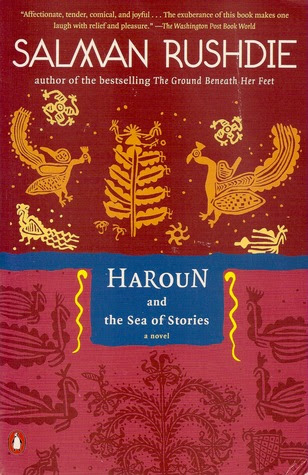
 Haroun and the Sea of Stories by Salman Rushdie *** 3 stars

A reread of a book I first read in 2012. I probably won't read it a third time but it was fun to revisit this. Haroun & the sea of stories begins in the country of Alifbay in a city ”so ruinously sad that it has forgotten its name.” Haroun is the only child of the storyteller Rashid Khalifa, and one day his father gets up in front of a huge audience, opens his mouth, and finds that he has run out of stories to tell. Harun sets out to fix that and discovers that the source of all stories is endangered by the villain Khattam-Shud, the Arch-Enemy of All Stories. 


Hyperion by Dan Simmons *** 3 stars

A Hugo Award Winner (1990) about six people on a journey to the planet Hyperion. In the style of the Canterbury Tales, each character tells a story explaining why they are going to Hyperion. I liked the scholar and the poet best I think. And maybe the detective. The soldier's tale is the only one that didn't really do much for me. The book has frequent allusions to John Keats, including the poem Hyperion, which is based on the lost epic poem the Titanomachy, which is about the struggle of the Olympian gods to overthrow their predecessors the Titans. That gave me a hint about some of the things that happen in the book. I don't like it enough to read the sequel right away but I will probably try it at some point.

People disagree about whether to stick with the first book, stop after the second book or read the whole series. 


I think I liked the other Delany books I have read better (Babel-17 and The Ballad of Beta-2 / Empire Star).

Here is what Neil Gaiman said about it in The Sandman Companion:
"My original plan [for The Song of Orpheus] was to do the equivalent of a series of jazz riffs, all on Orphic themes, spinning off of stories precisely like The Einstein Intersection. It would have been much weirder and more interesting than what I ended up writing." He says he kept hearing that people weren't familiar with the original story, so the story he wrote for Sandman was a more literal retelling.

Huh. Now that I've read The Einstein Intersection I can say that knowing the Orpheus story ahead of time (I finally read Metamorphoses in its entirety last year) didn't help. I will probably read something else by Delany someday (maybe Tales of Nevèrÿon but I am not a huge fan of his so far.

I listened to the audiobook read by Stefan Rudnicki from the library service hoopla digital. This book won the 1967 Nebula Award for Best Novel.


Review: Julian Comstock: A Story of 22nd-Century America (repost from GoodReads 2017)

Julian Comstock: A Story of 22nd-Century America Julian Comstock: A Story of 22nd-Century America by Robert Charles Wilson
My rating: 5 of 5 stars

This is a great adventure story - funny, dramatic, and bittersweet - and my favorite SF novel that I've read this year. The old-fashioned tone is completely convincing and switches easily between humorous moments and serious ones. The exposition is really well done, in such a way that it's probably quite accessible to people who don't read much SF (although it doesn't seem to be well known enough to get much of that readership).

Set a century and a half after a combination of peak oil + disease + economic collapse reduces modern civilization to Civil-War-level tech, this book takes place in a future North America where Canada is part of the United States, the presidency has become dynastic and is ruled by the Comstock family, and true political power is in the hands of the religious authority known as the Dominion. The post-apocalyptic society in the book emulates the 19th century, but it has all the American 19th century's flaws, without some of its key virtues; the actual 19th century was a time of overall progress, while the society in the book is clearly in decline. Oh, and the United States is at war with the Dutch over control of the Northwest Passage.

The narrator, Adam Hazzard, is a young writer. Adam makes friends with the president's nephew, Julian Comstock, whose life is loosely inspired by the life of Julian the Apostate. They get conscripted into the army while Julian is hiding his identity. Eventually Julian becomes a war hero and at the celebrations that follow, his actual identity is disclosed.

This review says that "Wilson himself described it by saying he was reading a US Civil War memoir called “Frank on a gunboat” and thought that was good as far as it went, but it would be better if it was Julian the Apostate on a gunboat and that's what this book is." Like the historical Julian, his goal is to reintroduce earlier traditions, but in this case, that means reimposing separation of church and state as public policy. Also, he wants to make a film about Darwin.

Along with Eifelheim Michael Flynn and Doomsday Book by Connie Willis this is one of the better science fiction books I've read that deals with religion although this one is coming at it from the other (irreligious) side. I loved everything about it and I will definitely read it again someday. 

“You must not make the mistake of thinking that because nothing lasts, nothing matters.”

There's an interesting interview with the author here
.


View all my reviews

Review: 2312 (repost from 2016 on GoodReads)

2312 2312 by Kim Stanley Robinson
My rating: 5 of 5 stars

2312 is a future history in which new habitats have been created throughout our solar system, on Mercury, Venus, Mars, several of Jupiter’s moons, Saturn and its moons, and inside many asteroids. Much of the plot revolves around the mystery of a series of terrorist attacks in the solar system, but the book has a very meandering pace and spends a lot of time focusing on other things. The book is a slowly developing romance between Swan Er Hong, from Mercury, and Wahram, from Iapetus, one of Saturn’s terraformed moons. (Robinson is having some fun with personality types here, as Swan is a mercurial character and Wahram is, well, saturnine… Swan was a hard character to like at times, but they’re both interesting and I loved reading about them.)

2312 takes a pretty balanced view of the future, and avoids the extremes of apocalyptic pessimism or shiny techno-utopia. The regular chapters are interspersed with various lists (written by Swan) fake nonfiction extracts that describe the colonization of the solar system, and stream of consciousness sections. I loved it; there aren't a whole lot of writers who can make exposition a pleasure to read, but Kim Stanley Robinson is one of them.

The descriptions of the settlement of the solar system are extremely detailed and clearly well researched. Much of the book takes place in Terminator, a moving city on Mercury. Terminator moves around Mercury on train tracks at the speed of the planet’s rotation, never staying in one place long enough to be scorched by Mercury’s dawn. The opening chapter describes the sunwalkers who come to Mercury to watch the sunrise.

Besides the colonization of space, the book examines body modification, the potential future of AI, and environmental issues. Swan has undergone several modifications of her body and brain, including having parts of animal brains implanted in her head so that she can whistle like a bird, implanting a quantum computer in her head, and modifying her reproductive organs so that she can both mother and father children. She has also ingested alien bacteria discovered in the oceans of Enceladus, one of Saturn's moons. (The AI developments in this book provide background for the more advanced quantum computer AI in Aurora.)

Earth is almost an ice-free planet but the terraforming techniques used off-planet usually won’t work on the already inhabited Earth:. "no slamming comets into it, for instance. So they bubbled their ship wakes with surfactants to create a higher albedo, and tried various levels of sulfur dioxide injected into the stratosphere, imitating volcanoes; but that had once led to disaster, and now they couldn’t agree on how much sunlight to block… no, Earth was a mess, a sad place. And yet still the center of the story. It had to be dealt with, as Alex had said, or nothing done in space was real."

I will definitely reread this book (and Aurora) but I want to read some of Kim Stanley Robinson’s other books first, especially The Wild Shore and its sequels The Gold Coast and Pacific Edge.

my favorite quotes:

"… as the sunwalkers stand on their points and watch, it’s not uncommon for devotees to become entranced by something in the sight, some pattern never seen before, something in the pulse and flow that snags the mind; suddenly the sizzle of the fiery cilia becomes audible, a turbulent roaring— that’s your own blood, rushing through your ears, but in those moments it sounds just like the sun burning. And so people stay too long. Some have their retinas burned; some are blinded; others are killed outright, betrayed by an overwhelmed spacesuit. Some are cooked in groups of a dozen or more. Do you imagine they must have been fools? Do you think you would never make such a mistake? Don’t you be so sure. Really you have no idea. It’s like nothing you’ve ever seen. You may think you are inured, that nothing outside the mind can really interest you anymore, as sophisticated and knowledgeable as you are. But you would be wrong. You are a creature of the sun. The beauty and terror of it seen from so close can empty any mind, thrust anyone into a trance."

"To simplify history would be to distort reality. By the early twenty-fourth century there was too much going on to be either seen or understood. Assiduous attempts by contemporary historians to achieve an agreed-upon paradigm foundered, and we are no different now, looking back at them. It’s hard to even assemble enough data to make a guess."

"[The sky] looked like a blue dome flattened at the center, perhaps a few kilometers above the clouds — she reached up for it — although knowing too that it was just a kind of rainbow made it glorious. A rainbow that was blue everywhere and covered everything. The blue itself was complex, narrow in range but infinite within that range. It was an intoxicating sight, and you could breathe it — one was always breathing it, you had to. The wind shoved it into you!"

"Here they were, on the only planetary surface on which you could walk freely, naked to the wind and the sun, and when they had a choice, they sat in boxes and stared at littler boxes..."

"Sometimes I think it's only post-scarcity that evil exists. Before that, it could always be put down to want or fear. It was possible to believe, as apparently you did, that when fear and want went away, bad deeds would too. Humanity would be revealed as some kind of bonobo, an altruistic cooperator, a lover of all."

"All landscape art reminds us: we live in a tabula rasa, and must write on it. It is our world, and its beauty is entirely inside our heads."

"Io, the innermost moon of Jupiter, a big as Luna. They yellow slag world, awesome upchucking of a moon's guts, regurgitation overland over until everything more volatile than sulfur has long since burned off. Sulfur, sulfur everywhere, and nary a place to stand. Four hundred live volcanoes bursting through the slag like angry boils, geysering sulfur dioxide hundreds of kilometers into the air… The hard crust on its surface, cooled only by contact with the chill vacuum of space, is so thin that in many places it would not support a standing person. Some early explorers found this out the hard way: walking too far away from their lander, they plunged through the sulfurous ground into red-hot lava and disappeared.

We think that because we live on cooler planets and moons, we live on safer ground than that. But it is not so."


View all my reviews

Review: Doomsday Book (repost from 2016 on GoodReads)

Doomsday Book Doomsday Book by Connie Willis
My rating: 4 of 5 stars

I found out about this book when GoodReads recommended it after I added To Say Nothing of the Dog. I hadn’t realized it was part of a series. Doomsday Book is the first book in Connie Willis’s Oxford Time Travel series, which is about historians at a near-future version of Oxford University who use time travel as part of their research. It won both the Hugo and the Nebula Awards for Best Novel in 1992.

This novel is a drama with some moments of comic relief, while To Say Nothing of the Dog is a comedy with some dramatic moments. Kivrin, an Oxford student studying medieval history, prepares to visit the fourteenth century. She is supposed to be sent to the year 1320 — but something goes wrong. She ends up in 1348 instead, shortly before Christmas…. which happens to be right before the Black Death arrives in England. Back in modern times, a dangerous strain of flu hits Oxford University. As the faculty tries to figure out what went wrong with Kivrin’s assignment and how to rescue her, they must address a crisis in their own time as well.

The only real complaint I have is about the modern-day section. This was written in 1992, so I can’t really blame Willis for not predicting that there would be cell phones in her near-future setting, but there were definitely answering machines in major institutions in 1992, and there aren’t any here. It’s hard to ignore because much of the plot revolves around telephone communication. But that's a minor thing, and it's an excellent book otherwise.

"Mr Dunworthy had told her it wouldn’t be anything like she imagined, and he was right, of course. But not about this mass. She had imagined it just like this, the stone floor and the murmured Kyrie, the smells of incense and tallow and cold."

"They’ve all died, she thought, and couldn’t make herself believe it. They’ve all been dead over seven hundred years."

"Are these the last days, the end of the world that God’s apostles have foretold?"
Yes, Kivrin thought. "No," she said. "No. It’s only a bad time. A terrible time, but not everyone will die. And there will be wonderful times after this. The Renaissance and class reforms and music. Wonderful times. There will be new medicines, and people won’t have to die from this or smallpox or pneumonia. And everyone will have enough to eat, and their houses will be warm even in the winter." She thought of Oxford, decorated for Christmas, the streets and shops lit. "There will be lights everywhere, and bells that you don’t have to ring."

"I wanted to come, and if I hadn’t, they would have been all alone, and nobody would have ever known how frightened and brave and irreplaceable they were."

"Most of it was terrible," she said softly, "but there were some wonderful things."


View all my reviews

Saturday, June 13, 2020

Review: The Fifth Season

The Fifth Season The Fifth Season by N.K. Jemisin
My rating: 5 of 5 stars

“Winter, Spring, Summer, Fall; Death is the fifth, and master of all”

Synopsis from GoodReads: Three terrible things happen in a single day. Essun, a woman living an ordinary life in a small town, comes home to find that her husband has brutally murdered their son and kidnapped their daughter. Meanwhile, mighty Sanze -- the world-spanning empire whose innovations have been civilization's bedrock for a thousand years -- collapses as most of its citizens are murdered to serve a madman's vengeance. And worst of all, across the heart of the vast continent known as the Stillness, a great red rift has been torn into the heart of the earth, spewing ash enough to darken the sky for years. Or centuries.

The book opens with the beginning of the worst Fifth Season in recorded history. The government maintains the Fulcrum, an army of enslaved orogenes with the ability to control energy, particularly that of the ground and temperature. Their abilities give them power geological activity and temperature so that they can both cause and prevent earthquakes.

The Fifth Season is the first book in the Broken Earth Trilogy. I think it could fit into either science fiction or fantasy; it is hard to tell because it leans so heavily on Clarke's Third Law. 

The Fifth Season is darker than most books I read. I suspect the question of whether it has a pessimistic worldview doesn't make much sense outside the context of the trilogy as a whole, so I will come back to that when I finish rereading The Obelisk Gate and The Stone Sky.

The first book is technically mostly setup when you look at it in relation to the other books, but
it doesn't feel that way! I think this is something to do with how the book does so much of its worldbuilding through characterization & plot. In this book, all those things go together perfectly, while the other books rely more on exposition.

There are three points of view: the young girl Damaya, in training as an orogene; the young woman Syenite; and the grieving mother Essun. Essun's perspective is given in second person and present tense; there is a plot-related reason for that, but Jemisin doesn't reveal it in the first book. I loved the writing! Essun's perspective felt odd at first but I got used to it. Here are some of my favorite quotes:

- “Yumenes is not unique because of its size. There are many large cities in this part of the world, chain-linked along the equator like a continental girdle. Elsewhere in the world villages rarely grow into towns, and towns rarely become cities, because all such polities are hard to keep alive when the earth keeps trying to eat them… but Yumenes has been stable for most of its twenty-seven centuries.
Yumenes is unique because here alone have human beings dared to build not for safety, not for comfort, not even for beauty, but for bravery. The city’s walls are a masterwork of delicate mosaics and embossing detailing its people’s long and brutal history. The clumping masses of its buildings are punctuated by great high towers like fingers of stone, hand-wrought lanterns powered by the modern marvel of hydroelectricity, delicately arching bridges woven of glass and audacity, and architectural structures called balconies that are so simple, yet so breathtakingly foolish, that no one has ever built them before in written history. (But much of history is unwritten. Remember this.)”

- “This is what you must remember: the ending of one story is just the beginning of another. This has happened before, after all. People die. old orders pass. New societies are born. When we say the world has ended, it's usually a lie, because the planet is just fine. But this is the way the world ends. This is the way the world ends. This is the way the world ends. For the last time.”

- “Friends do not exist. The Fulcrum is not a school. Grits are not children. Orogenes are not people. Weapons have no need of friends.”

Thursday, April 30, 2020

Review: Space Opera

Space Opera Space Opera by Catherynne M. Valente
My rating: 4 of 5 stars

I have read one other book by the author, Deathless ,a fantasy set during the Russian Revolution. It is much darker than this one, which is a comedy. The premise is basically a galactic version of the Eurovision Song Contest: the Megagalatic Grand Prix, invented in the wake of interstellar wars.

When it was all done and said and shot and ignited and vaporized and swept up and put away and both sincerely and insincerely apologized for, everyone left standing knew that the galaxy could not bear a second go at this sort of thing. Something had to be done. Something mad and real and bright. Something that would bring all the shattered worlds together as one civilization.

You don't have to win to survive, just don't be dead last!

It's pretty obvious that this book is influenced by the Hitchhikers Guide to the Galaxy. I caught a few brief references, but the main thing this book takes from Adams is the concept behind the nonfiction-style entries for laws of the universe that are known as Goguenar Gorecannon's Unkillable Facts. For example:

Seventh Unkillable Fact: Dying happens to everyone, even stars. Even the stuff between the stars. But if you believe in yourself and achieve your goals, you can die so hard that no one will ever forget you, and that’s almost as good as not dying at all. Well, it isn’t, really, it isn’t at all, and believing and achieving is just something sportscasters say, but what are you gonna do, not die? Try it. I’ll wait.

But it didn't feel overly derivative to me. This was a lot of fun, and the silliest book I have read in a long time. There is a plot, sort of, or at least a bunch of things happen, and there are main characters, namely the members of a defunct glam rock band called Decibel Jones and the Absolute Zeroes. But mostly I liked this book for the narrator, who is highly quotable.

But in the end, all wars are more or less the same. If you dig down through the layers of caramel corn and peanuts and choking, burning death, you’ll find the prize at the bottom and the prize is a question and the question is this: Which of us are people and which of us are meat?

View all my reviews

Sunday, April 26, 2020

Review: The Lucky Strike

The Lucky Strike The Lucky Strike by Kim Stanley Robinson
My rating: 4 of 5 stars

This book includes the novella, "The Lucky Strike," along with an essay and an interview. The novella is an alternate history story, in which Col. Tibbets, the pilot of the Enola Gay, crashes his plane and dies a few days before he's supposed to fly the mission to drop the atomic bomb on Hiroshima. A backup crew flies instead. I can't say more about that, and exactly what changes, without giving too much away, but it's an excellent story. I have never read Robinson's short fiction before, but I was impressed.

Next is an essay, "A Sensitive Dependence on Initial Conditions" that uses the novella as a jumping-off point to looks at different models of historical analysis, from the point of view of a world where the first story is the true history. This was pretty dense, but it was interesting.

There are some great bits in the interview. I liked what KSR had to say about writing The Years of Rice and Salt:

"It came to me in the late 70s and it was indeed a kind of AHA moment, in that I was thinking about alternative histories, wanting ideas, and thought of the one for The Lucky Strike, too, and looking over the alternative histories I decided what was needed was the most major change you could think of. that did not simply change the game so much that it wiped away everything... Because you want comparison. So I was thinking, well what would be the biggest change that would still work in terms of comparison to our history, and it seemed to me that Europe's conquering the world was so big that if it hadn't happened -- and then it hit me, and I said Wow and ran to write it down quick before I forgot it ... So, once I had the idea, I knew I couldn't write it, that what it implied was beyond what I was capable of expressing. I wondered if I would ever be capable of such a thing (I have a couple of good ideas I've never written because I can't think how to yet) but after the Mars novels I figured I had worked out the method, and I was feeling bold. I'm glad I wrote it when I did; I don't know if I have the brain cells for it now. Although that's partly that book's fault, because I blew out some fuses writing that one that were never replaced."

View all my reviews

Friday, April 24, 2020

Book Beginnings #17: Space Opera by Catherynne M. Valente


Book Beginnings is hosted by Rose City Reader. The weekly post goes up every Thursday and bloggers can add their links all week. 


Synopsis: A century ago, the Sentience Wars tore the galaxy apart and nearly ended the entire concept of intelligent space-faring life. In the aftermath, a curious tradition was invented-something to cheer up everyone who was left and bring the shattered worlds together in the spirit of peace, unity, and understanding.

Once every cycle, the civilizations gather for the Metagalactic Grand Prix - part gladiatorial contest, part beauty pageant, part concert extravaganza, and part continuation of the wars of the past. Instead of competing in orbital combat, the powerful species that survived face off in a competition of song, dance, or whatever can be physically performed in an intergalactic talent show. The stakes are high for this new game, and everyone is forced to compete.

This year, though, humankind has discovered the enormous universe. And while they expected to discover a grand drama of diplomacy, gunships, wormholes, and stoic councils of aliens, they have instead found glitter, lipstick and electric guitars. Mankind will not get to fight for its destiny - they must sing.

A one-hit-wonder band of human musicians, dancers and roadies from London - Decibel Jones and the Absolute Zeroes - have been chosen to represent Earth on the greatest stage in the galaxy. And the fate of their species lies in their ability to rock. (from GoodReads)

The beginning:

Once upon a time on a small, watery, excitable planet called Earth, in a small, watery, excitable country called Italy, a soft-spoken, rather nice-looking gentleman by the name of Enrico Fermi was born into a family so overprotective that he felt compelled to invent the atomic bomb. Somewhere in between discovering various heretofore cripplingly socially anxious particles and transuranic elements and digging through plutonium to find the treat at the bottom of the nuclear box, he found the time to consider what would come to be known as the Fermi Paradox. If you’ve never heard this catchy little jingle before, here’s how it goes: given that there are billions of stars in the galaxy quite similar to our good old familiar standby sun, and that many of them are quite a bit further on in years than the big yellow lady, and the probability that some of these stars will have planets quite similar to our good old familiar knockabout Earth, and that such planets, if they can support life, have a high likelihood of getting around to it sooner or later, then someone out there should have sorted out interstellar travel by now, and therefore, even at the absurdly primitive crawl of early-1940s propulsion, the entire Milky Way could be colonized in only a few million years.

So where is everybody?


This is my current audiobook! It's the silliest thing I have read in some time, but I'm really enjoying it. I have read one other book by the author; a few years ago I read Deathless, a fantasy inspired by Russian folklore and set during the Russian Revolution. I liked it, but this is a completely different kind of book. 

Monday, April 29, 2019

Deal Me In Update: April


Here are the stories I read in April!


Hearts: Stories on Audio


"Snow" by John Crowley -- Lightspeed podcast. The link goes to the magazine where you can either read it or listen or both. The author discussed the story with Lightspeed here, and I had a hard time figuring out what else to say about it, but I thought it was really interesting.


Clubs: Classic SF


"Occam's Scalpel" -- my first Theodore Sturgeon story. The introduction says:  
Although his stories made clever use of science, he was never known as an hard sf writer, but rather as the finest literary craftsman of his day in the genre… “Occam’s Scalpel” is on the edge of being not sf at all.

Which makes me wonder why this is included in an anthology of hard sf. Anyway, I didn't like this one & didn't feel like writing about it. If Sturgeon is as good as his reputation has it,  I'm sure he's written better than this!

"Atomic Power" by Don A Stuart -- Another disappointing story.

Spades: Contemporary SF

"All the Hues of Hell" Gene Wolfe -- I have previously read Latro in the Mist by this author, and I have The Fifth Head of Cerberus on my TBR list. Wolfe passed away earlier this month, and this is the first short story I have read by him. The editors' introduction says: Gene Wolfe’s body of work in the science fiction field, along with that Delany, Dick, and Le Guin, is perhaps the most influential of any writer f the past two decades. Of them all, Wolfe is perhaps the least interested in the use of pure science in his fiction... Wolfe’s fiction is so rich and evocative, his style s precise and complex, that much f his influence has been stylistic. "All the Hues of Hell" is a story in which theoretical physics and metaphysics combine. It has, initially, the ring of a hard sf situation: three characters on a ship in space approaching an alien planet, one of them mad, or dead. Quickly the story becomes mysterious,  ambiguous, and disturbing... 

I liked this one, but it was weird.


Review: The Left Hand of Darkness

The Left Hand of Darkness The Left Hand of Darkness by Ursula K. Le Guin
My rating: 5 of 5 stars

The Left Hand of Darkness is one of my favorite science fiction novels and definitely my favorite by Le Guin. This was my third time reading it. This book won the Hugo & Nebula Awards for Best Novel in 1970. This new edition has an excellent afterword by Charlie Jane Anders.

Synopsis: A lone human ambassador is sent to the icebound planet of Winter, a world without sexual prejudice, where the inhabitants’ gender is fluid. His goal is to facilitate Winter’s inclusion in a growing intergalactic civilization. But to do so he must bridge the gulf between his own views and those of the strange, intriguing culture he encounters...

Embracing the aspects of psychology, society, and human emotion on an alien world, The Left Hand of Darkness stands as a landmark achievement in the annals of intellectual science fiction.
(from the description in the library catalog)

Plot: Definitely a slow burn, but exciting once it gets going, and very dramatic in the second half.

Setting: Winter, aka Gethen, is a planet in an ice age is one of my favorite settings in science fiction and definitely my favorite from Le Guin. I love the mythology and religions she created for it and the descriptions. This book takes its time establishing the world in which it takes place, and Le Guin later wrote two short stories in this setting: "Winter's King" and "Coming of Age in Karhide." They are both in the Library of America edition of Le Guin's writings: Hainish Novels & Stories, Vol. 1: Rocannon’s World / Planet of Exile / City of Illusions / The Left Hand of Darkness / The Dispossessed / Stories.

Characters: Genly Ai is the ambassador from the intergalactic civilization known as the Ekumen, a union of planets designed to increase communication and knowledge throughout the known universe. He has been sent alone to convince Gethen to join the Ekumen, and when the book opens he is staying in Ehrenrang, the capital city of Karhide, a country on Gethen. Genly comes across (and probably is intended to come across) as a bit reactionary and shortsighted with respect to the gender issues raised in the book. If you have read it, you know what I mean, but I shouldn't give too much away. The prime minister of Karhide, Estraven, is the second narrator. Estraven has haunted me since I first read the book. He is one of my favorite fictional characters: an inspiring but flawed person in difficult circumstances and more proactive than LeGuin's characters usually are.

Theme: besides the obvious gender issues, it also touches on themes of patriotism and mysticism.

Style: Lyrical and endlessly quotable! Some of my favorite quotes:

"I'll make my report as if I told a story, for I was taught as a child on my homeworld that Truth is a matter of the imagination. The soundest fact may fail or prevail in the style of its telling: like that singular organic jewel of our seas, which grows brighter as one woman wears it and, worn by another, dulls and goes to dust. Facts are no more solid, coherent, round, and real than pearls are. But both are sensitive.

The story is not all mine, nor told by me alone. Indeed I am not sure whose story it is; you can judge better. But it is all one, and if at moments the facts seem to alter with an altered voice, why then you can choose the fact you like best; yet none of them are false, and it is all one story."

"To learn which questions are unanswerable, and not to answer them: this skill is most needful in times of stress and darkness."

"How does one hate a country, or love one? Tibe talks about it; I lack the trick of it. I know people, I know towns, farms, hills and rivers and rocks, I know how the sun at sunset in autumn falls on the side of a certain plowland in the hills; but what is the sense of giving a boundary to all that, of giving it a name and ceasing to love where the name ceases to apply? What is love of one's country; is it hate of one's uncountry? Then it's not a good thing. Is it simply self-love? That's a good thing, but one mustn't make a virtue of it, or a profession... Insofar as I love life, I love the hills of the Domain of Estre, but that sort of love does not have a boundary-line of hate. And beyond that, I am ignorant, I hope."

"Season is not a hemispheric effect but a global one, a result 
of an ellipsoid orbit. At the far and slow-moving end f the orbit, approaching and departing from aphelion, there is just enough loss of solar radiation t disturb the already uneasy weather patterns, chill down what is cold already, and turn the wet gray summer int white violent winter. Dryer than the rest of the year, winter might be pleasanter if it were not for the cold. The sun, when you see it, shines high; there is no slow bleeding away of light int the darkness, as on the polar slopes of Earth where cold & night come on together. Gethen has a bright winter, bitter, terrible, and bright." 

"Smoke painted from fiery mouths that opened out of the ice. Estraven stood there in harness beside me looking at that magnificent and unspeakable desolation. "I'm glad I have lived to see this," he said. I felt as he did. It is good to have an end to journey towards; but it is the journey that matters, in the end."


View all my reviews

Sunday, April 7, 2019

Review: The Hitchhiker's Guide to the Galaxy

The Hitchhiker's Guide to the Galaxy The Hitchhiker's Guide to the Galaxy by Douglas Adams
My rating: 4 of 5 stars

“This planet has - or rather had - a problem, which was this: most of the people living on it were unhappy for pretty much all of the time. Many solutions were suggested for this problem, but most of these were largely concerned with the movement of small green pieces of paper, which was odd because on the whole it wasn't the small green pieces of paper that were unhappy.”

I am sure some people will be shocked that I gave this only four stars! I really enjoyed this, but my second time reading it I just didn't have the love for it that I did the first time. I reread this immediately after my audio reread of Good Omens (which I still need to review) which may have something to do with it. There are some brilliant bits, of course, and it still made me laugh, but I was not as captured by the characters and crazy happenings as I was the first time. Definitely still worth reading, if you have not read it yet.

“For instance, on the planet Earth, man had always assumed that he was more intelligent than dolphins because he had achieved so much—the wheel, New York, wars and so on—whilst all the dolphins had ever done was muck about in the water having a good time. But conversely, the dolphins had always believed that they were far more intelligent than man—for precisely the same reasons.”

View all my reviews

Tuesday, April 2, 2019

Deal Me In: March Stories Read (4)

Here are the stories I read in March!


Spades: Contemporary Science Fiction


John M. Ford, "Heat of Fusion"


This is a new author for me. The story is told through diary entries of a man with terminal radiation poisoning. This is a hard one to describe... it's intense, and very internally focused, with very little setting description. This one is captivating. 


Robert L Forward: "The Singing Diamond"


A search for valuable ores in the Asteroid Belt leads to the discovery of a diamond disk with life in it. 

This probably the most boring story I have read for this challenge, and that's all I'm going to say about that. The SF Encyclopedia notes that this is Robert Forward's first published story, so maybe he wrote better ones later on, but I'm not sure why the editors were so impressed with it. Its just missing something, I'm afraid. 


Bruce Sterling: "The Beautiful & the Sublime" 


I have heard of Bruce Sterling before, but I don't think I have read anything by him. This is a far-future story that looks at how AI might transform society. The central plot, though, is about the building of an aircraft that mimics the flight of a dragonfly. The really revolutionary thing about it, from the point of view of the characters, is that the craft is designed to fly without a computer:

"Why?" I said. "What happened to its controls?"

Somps grinned for the first time, exposing long, narrow teeth. "They haven't been invented yet. I mean, there aren't algorithms for its wing kinematics. Four wings flapping -- it generates lift through vortex-dominated flow fields. You've seen dragonflies..."

I liked this bit where the narrator reflects on the history of science:


"... I confess that I felt the loss of those glory days, which we now see, in hindsight, as the last sunset glow of the Western analytic method. Those lost battalions of scientists, technicians, engineers!

Of course, to the modern temperament, this lopsided emphasis on rational thought seems stifling. Admittedly machine intelligence has its limits; it's not capable of those human bursts of insight that once advanced scientific knowledge by leaps and bounds. The march of science is not the methodical crawling of robots.

But who misses it?
"

I will not spoil it, but I definitely recommend this one if you can find it. 


Hearts: Stories on Audio


HG Wells: 
"The Crystal Egg"

The main character, Mr. Cave,  owns an antique shop. One antique item that comes into his possession is a crystal egg. One night he observes a light coming from the egg and examines it. For a moment, he has a glimpse of  "a view of a wide and spacious and strange country" but soon the view vanishes. After a while, he starts to suspect that the crystal egg is showing the planet Mars. After that... well, there are some mysterious happenings, but I guess I was expecting something more dramatic. I have read The Time Machine,  The Island of Dr. Moreau, and The War of the Worlds, and those books had a similar feel to the classic horror of the same era (Algernon Blackwood, M.R. James, ect). This is the first short story I have read by him, and it is very low-key in comparison to those novels. I liked it, but it did not blow me away. 


Thursday, February 28, 2019

Deal Me In: January-Febuary stories read (7)

This is what I have read so far for the short stories/poetry selections I planned for the Deal Me In challenge, except for  the poem "The Eve of St Agnes." I already wrote a separate post about that one. 


Clubs: Classic Science Fiction


Raymond Z. Gallun: "Davy Jones's Ambassador" 1935 1/15/2019

I really liked this one! This is an early first contact story (about first contact with aliens, that is) set at the bottom of the ocean, rather than in space. It is clever, imaginative and a bit sad. Probably my favorite of those I have read so far. 


James Blish: "Surface Tension" 1952 1/28/2019 


Discovering that the sun will soon explode, scientists create microhumans who can live in a drop of water. This was ok, but not quite as good as the previous story, I thought.


Henry Kuttner and C.L. Moore: "Mimsy Were the Borogoves" 1943 2/19/2019


This story is about children who discover another dimension. The editors' introduction says: "Mimsy Were the Borogoves" is one of his [Kuttner's] genre masterpieces, in which he alludes to Lewis Carroll (and invokes Carrolls play with mathematical logic) as he parodies the advanced theories of child psychologists and the educational toy industry. If geometric sense really is learned by children at an early age by interacting with the world, most especially with their toys, what if they got toys from the fourth dimension? 


Kate Wilhelm "The Planners" 1968 2/23/2019 
Winner of the Nebula Award for Best Short Story
This is basically a mad scientist story. I didn't think this was anything special, I'm afraid, but I will wait and see if it has any interesting parallels or connection with the other stories I haven't read yet. 


Spades: Contemporary Science Fiction 


Gregory Benford "Exposures" 1982 2/5/2019


Kind of a slice of life story, except that the characters are astronomers. This wasn't a bad story, but it was a bit dry.  


Hearts: Stories on Audio


Peter Beagle: We Never Talk About My Brother Podcastle podcast 
2/17/2019

This is probably not my favorite Peter Beagle story; that's probably either "Come Lady Death" or "Salt Wine" (which I read years ago in The Line Between). This is a story about someone who can make stories come true. It is a little bit eerie, but not quite a horror story. As in "Salt Wine," there's a great narrator, but for some reason, the other aspects of the story weren't quite as compelling to me. I have 3 more Podcastle stories on my Deal Me In list, and I might listen to more of them next year. 


Natalia Theodoridou: The Birding: A Fairy Tale

World Fantasy Award Winner for Short Fiction: 2018 
Strange Horizons podcast (click through to listen or read the story)
2/28/2019

The premise of this story is a plague that is turning people into birds. The narrator, Maria, lives in contemporary Greece. She tries to avoid the plague and tells a story about birds to her unborn child, which will eventually dovetail (ha!) with the frame story. This was weird, maybe a bit too surreal for my taste. 


Monday, January 28, 2019

Review: Roadside Picnic

Roadside Picnic Roadside Picnic by Arkady Strugatsky
My rating: 3 of 5 stars

The introduction to this edition is by Ursula Le Guin. Here is part of her description of the book:

Roadside Picnic is a first contact story with a difference. Aliens have visited the Earth and gone away again, leaving behind them several landing areas (now called the Zones) littered with their refuse. The picnickers have gone; the pack rats, wary but curious, approach the crumpled bits of cellophane, the glittering pull tabs from beer cans, and try to carry them home to their holes.

Most of the mystifying debris is extremely dangerous. Some proves useful — eternal batteries that power automobiles — but the scientists never know if they are using the devices for their proper purposes or employing (as it were) Geiger counters as hand axes and electronic components as nose rings.

In the traditional first contact story, communication is achieved by courageous and dedicated spacemen, and thereafter ensues an exchange of knowledge, a military triumph, or a big business deal. Here, the visitors from space, if they noticed our existence at all, were evidently uninterested in communication; perhaps to them we were savages, or perhaps pack rats. There was no communication; there can be no understanding.


I doubt I'm the only one who thought of Peter Watts’s Blindsight when I read that description (the last paragraph above). (Or the other way around, as Blindsight came out in 2006). I really liked the set-up, so this book drew me in at the beginning, but somewhere around the halfway point the characters and dialogue started to seem a bit perfunctory, and if it hadn’t been so short I might not have bothered to finish it, but I was curious. The ending is disturbing, but I think it would have had more impact if I had been more invested in the story earlier on.

View all my reviews

Wednesday, January 2, 2019

Top 10 Tuesday: The Best Books I Read in 2018

A top 10 +1, actually. 

I wrote reviews for most of these, but there are a few I just didn't get around to reviewing. 

Njals Saga (author unknown) review

Too Like the Lightning/Seven Surrenders by Ada Palmer (Terra Ignota series)

I am lumping these two together because they are so closely connected, with the second book picking up right where the first leaves off. These two books are probably my favorite science fiction that I read this year. These books take place in a drastically changed future world that combines aspects of what we would think of as a utopian society. The title of Too Like the Lightning  comes from Romeo and Juliet: "It is too rash, too unadvised, too sudden,/Too like the lightning, which doth cease to be/Ere one can say 'It lightens.' While in the play, Juliet is expressing doubt about Romeo's constancy, the allusion is probably meant to raise questions about the attempts at utopianism depicted in the book. 

I didn't write a real review for these books, so instead, here are some quotes:

from Too Like the Lightning:
"Man is more ambitious than patient. When we realize we cannot split a true atom, cannot conquer the whole Earth, we redefine the terms to fake our victory, check off our boxes and pretend the deed is done."  

from Seven Surrenders:
"If you lived through it, you must remember vividly when you first heard that number, where you were—out shopping, sharing dinner—who first told you, what the wind smelled like. Tens of thousands of days fade into memory's melting pot, but not the day Death first took someone you loved, not that day. If, on the other hand, you join me from remote posterity, then the picture must be altogether different. Two thousand, two hundred and four: in the coldness of a history book it must seem like nothing-- Stalin killed as many in one weekend-- and it must fade too beside the millions of the World Wars. Not so for us. For three centuries we had lived out our rose-tinted daydream, convinced that we were peaceful creatures, good at heart, like Locke or Jean-Jacques Rousseau's Noble Savages; now we woke to find ourselves still brutish humans in the thrall of Hobbes."  

Splintered Light: Logos and  Language in Tolkiens World by Verlyn Flieger 
review

Good Omens by Neil Gaiman and Terry Pratchett (reread) - In which an angel and a demon team up to stop the end of the world. I've never reviewed this, but I've read it three times. I mentioned this in a previous Top 10 Tuesday for cozy winter reads, but I have to mention it here, too. 

“Don't tell me from genetics. What've they got to do with it?" said Crowley. "Look at Satan. Created as an angel, grows up to be the Great Adversary. Hey, if you're going to go on about genetics, you might as well say the kid will grow up to be an angel. After all, his father was really big in Heaven in the old days. Saying he'll grow up to be a demon just because his dad _became_ one is like saying a mouse with its tail cut off will give birth to tailless mice. No. Upbringing is everything. Take it from me.” 

Eichmann in Jerusalem by Hannah Arendt review

The Iliad by Homer (reread)  review  one of my favorites!

Farmer Giles of Ham by J.R.R.Tolkien (reread) review 

The Silmarillion by J.R.R.Tolkien (reread) review (I posted this review to GoodReads as well as my blog, but my blog automatically takes out the hidden comments in spoiler tags and I am not sure how to add them back in while keeping the spoiler tags. I should fix that, but for now, I have linked to GoodReads.) Also one of my favorites

Manfred by Lord Byron review a new favorite!

Ka: Dar Oakley in the Ruin of Ymr by John Crowley review 


The Children of Hurin by J.R.R.Tolkien (reread) - In December, I read this for the second time. (I had previously read most of it in Unfinished Tales, before it was published as a standalone book, so really it was more like the third time). I want to write something about my reread when I get around to it. The best piece of writing I've read about this book is this essay by lintamande at tumblr. She's quite right to note that, as grim as this tale is, Turin's choices overall aren't as futile and self-destructive as those of some other characters, and his accomplishments are not altogether useless. 


Monday, December 31, 2018

Deal Me In Challenge list for 2019


This challenge is hosted by Jay at Bibliophilopolis. For this challenge, you select 52 stories to read in 2019 and then assign each of them to a card in a deck of cards, drawing one card each week and then reading the story that matches the card.

The stories for the first 2 suits are from The Ascent of Wonder: the Evolution of Hard SF, edited by David Hartwell and Kathryn Cramer. I selected these using the Wikipedia page, which makes it easy to see the year of publication for each story. The table of contents in the book itself is not in chronological order, for some strange reason. I'll probably read the whole book by the end of the year, but I will use this challenge to decide which stories to read first.

I am not sure if I can read all of these, but if I have to change something I will probably cut back on another challenge. After all, this one is probably one of the easier challenges to fit into the year, especially since I have designated one of my suits for stories on audio. 

I probably won't review all of these, but I will do a few round-up posts.

Clubs: Classic SF Short Stories

A - H.G. Wells: "The Land Ironclads" 1903
2 - Rudyard Kipling: "With the Night Mail" 1909
3 - D
on A Stuart: "Atomic Power" 1934 4/15/2019
4 - Raymond Z. Gallun: "Davy Jones's Ambassador" 1935 1/15/2019
5 - Hal Clement:  "Proof” 1942 8/6/2019
6 - Henry Kuttner and C.L. Moore: "Mimsy Were the Borogoves" 1943 2/19/2019
7 - Raymond F. Jones: "The Person from Porlock" 1947

8 - Philip Latham: "The Xi Effect" 1950 6/23/2019
9 - Arthur C. Clarke: "The Star" 1955 7/28/2019
10 - James Blish: "Surface Tension" 1952   1/28/2019
J - Katherine Maclean: "The Snowball Effect" 1952
Q - Philip K. Dick: "The Indefatigable Frog" 1953
K  - J.G. Ballard: "Cage of Sand" 1963 8/31/2019

Spades: Contemporary SF Short Stories 
(using a broad definition of "contemporary": 1968-present)

A - Kate Wilhelm "The Planners" 1968  2/23/2019
2 - Poul Anderson "Kyrie" 1969 8/7/2019
3 - Gregory Benford "Exposures" 1982 2/5/2019
4 - Theodore Sturgeon "Occam's Scalpel" 1971  4/15/2019
5 - J.G. Ballard "Prima Belladonna" 1971
6 - Ursula K. Le Guin "The Author of the Acacia Seeds" 1974 (reread)
7 - Ian Watson "The Very Slow Time Machine" 1978 8/15/2019
8 - Robert L. Forward "The Singing Diamond" 1979  3/14/2019
9 - William Gibson "Johnny Mnemonic" 1981
10 - Bruce Sterling 
"The Beautiful & the Sublime" 1986 4/1/2019
J  - Gene Wolfe "Procreation" 1984
Q  - John M. Ford "Heat of Fusion" 1984 3/9/2019
K - Gene Wolfe "All the Hues of Hell" 1987 4/29/2019

Diamonds: Poetry

A - John Keats: The Eve of St. Agnes     2/13/2019 
2 - Percy Shelley: Ode to the West Wind (reread) 
3 - Samuel Taylor Coleridge: The Rime of the Ancient Mariner (reread) 
4 - John Greenleaf Whittier: Snowbound 
5 - Tennyson: Ulysses (reread) 7/31/2019
6 - Tennyson: The Lotus-Eaters 5/19/2019
7 - Arthur Hugh Clough: Say Not the Struggle Naught Availeth 
8 - W.B. Yeats: The Song of Wandering Aengus (reread)
9 - Yeats: Easter 1916 (reread) 
10 - Pablo Neruda: Explicar Algunas Cosas (I Explain a Few Things) (reread) 7/25/2019
J - Neruda: Canto a la madres de los milicianos muertos (Songs for the Mothers of Slain Militiamen)
Q - Neruda: Oda a la critica (Ode to Criticism) 
K - Neruda: Oda a la sal (Ode to Salt)

Hearts: Stories on audio 

A - Edgar Allen Poe: A Descent into the Maelstrom LibriVox
2 - Nathaniel Hawthorne: Rappaccinis Daughter LibriVox 8/2/2019
3 - Jules Verne: In the Year 2889 LibriVox
4 - HG Wells:  The Star LibriVox 6/28/2019
5 - HG Wells: The Crystal Egg LibriVox 3/23/2019
6 - Algernon Blackwood: A Victim of Higher Space LibriVox 
7 - Neil Gaiman: The Truth is a Cave in the Black Mountains - library audio (downloadable ebook) (reread) 6/1/2019
8 - Natalia Theodoridou: The Birding: A Fairy Tale: Strange Horizons podcast (World Fantasy Award for Short Fiction 2018) 2/28/2019
9 - Peter Beagle: Come Lady Death Podcastle podcast (reread)
10 - John Crowley: Snow 
Lightspeed podcast (http://www.lightspeedmagazine.com/fiction/snow/) 4/14/2019
J - Peter Beagle: We Never Talk About My Brother Podcastle podcast 2/17/2019
Q  - NK Jemisin: Sinners, Saints, Dragons, and Haints, in the City Under the Still Waters Podcastle podcast [found on this page: http://podcastle.org/new-to-podcastle]
K -  Ken Liu: The Paper Menagerie Podcastle podcast


I Have Moved to WordPress!

 I will see if I can update my links for FrightFall #Readathon and I think I might leave the blog up (why not?) but future posts will be at ...